
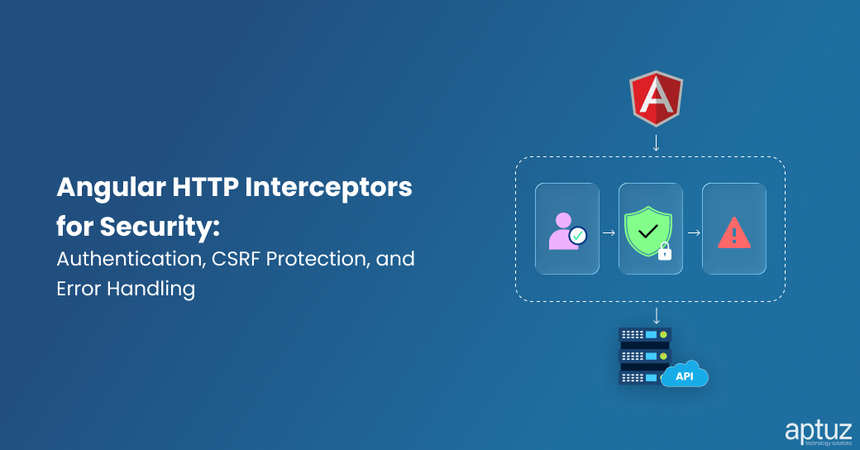
When building an Angular application, managing authentication, request headers, and sensitive data across multiple API calls can become challenging. But what happens when authentication information is missing, sensitive data is exposed, or unauthorized access is not handled properly?
These issues can create security risks and affect application reliability. Angular HTTP Interceptors help address these challenges by providing a centralized way to manage authentication, request headers, and error handling.
In this article, we'll explore how HTTP Interceptors work, common security risks, and practical ways to improve the security of your Angular applications.
What Are Angular HTTP Interceptors?
Angular HTTP Interceptors provide a centralized way to intercept and process HTTP requests and responses before they are sent to or received from the backend. They allow developers to apply common logic to API communication without repeating the same code across multiple components and services.
For example, an interceptor can automatically add authentication tokens or required HTTP headers to outgoing requests. It can also handle common response scenarios, such as unauthorized (401) responses, errors, or other application-wide HTTP behaviors.
Because the interceptor sits between the Angular application and the backend API, it provides a convenient place to implement cross-cutting concerns related to HTTP communication.
Why Interceptors Matter
Before implementing security measures, it is important to understand where potential risks exist in an Angular application. Most modern Angular applications rely heavily on APIs to retrieve, update, and manage data. This makes communication between the frontend and backend an important part of the application’s security.
Angular’s HttpClient is responsible for making HTTP requests to APIs. As an application grows, these requests can be made from multiple components and services. Managing authentication, headers, error handling, and other security-related requirements separately for every request can result in duplicated and inconsistent code.
This is where HTTP Interceptors become useful. An interceptor provides a centralized mechanism for inspecting and modifying outgoing HTTP requests and handling incoming HTTP responses. For example, authentication information can be added to requests automatically instead of requiring developers to manually implement the same logic throughout the application.
Without a centralized approach, developers may end up duplicating logic across services or overlooking required authentication information in certain API requests.
By using HTTP interceptors, developers can:
- Maintain consistency: Apply common HTTP handling logic across API requests.
- Reduce code duplication: Avoid repeating authentication and error-handling logic across services.
- Improve maintainability: Update shared HTTP behavior in one place.
- Support application security: Handle authentication information and API errors consistently.
However, interceptors should be considered an additional layer of protection and should not replace server-side authentication, authorization, and validation.
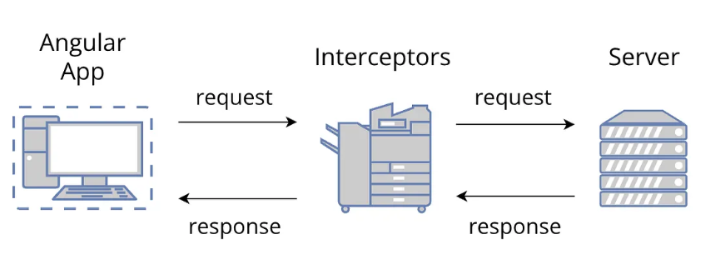
Suggested fig name: Angular HTTP Interceptor Request and Response Flow
Why Centralized Authentication Matters
In an Angular application, authentication information often needs to be included with requests sent to protected APIs. If developers manually attach authentication tokens to individual API calls, the same security logic must be repeated across multiple services and components.
This approach can easily lead to inconsistencies. A developer may forget to include the token in a newly added API call, use different authentication logic in different services, or make changes in one location without updating the others. These gaps can result in requests being sent without the required authentication information.
Centralizing authentication logic helps ensure that the same security mechanism is applied consistently across the application. Angular HTTP Interceptors provide a suitable place to implement this centralized behavior by intercepting outgoing requests and adding the required authentication information before the request reaches the backend.
Attaching Authentication: Ensuring Every Request is Secure
One of the most critical responsibilities of an interceptor is to ensure that every request carries proper authentication.
Example:
export const authInterceptor: HttpInterceptorFn = (req, next) => {
  const secureReq = req.clone({
    withCredentials: true
  });

  return next(secureReq);
};
Why this matters:
- Ensures session cookies are always sent
- Prevents accidental unauthenticated API calls
- Works with HttpOnly cookies, which are not accessible via JavaScript
This reduces the risk of session hijacking, especially when combined with secure cookie settings.
CSRF Protection: Securing Automatic Cookie Behavior
When using cookies, browsers automatically attach them to requests. While convenient, this introduces Cross-Site Request Forgery (CSRF) risks.
Solution: Add CSRF Tokens via Interceptor
export const csrfInterceptor: HttpInterceptorFn = (req, next) => {
  const token = getCsrfToken();

  if (token) {
    req = req.clone({
      headers: req.headers.set('X-XSRF-TOKEN', token)
    });
  }

  return next(req);
};
How it works:
- Server generates a CSRF token
- Angular attaches it via interceptor
- Server validates the token
Without this, attackers can exploit auto-sent cookies to perform unauthorized actions.
Handling Unauthorized Access Globally
Security is not just about preventing attacks—it’s also about handling failures correctly.
Example:
export const errorInterceptor: HttpInterceptorFn = (req, next) => {
  return next(req).pipe(
    tap({
      error: (err) => {
        if (err.status === 401) {
          // Redirect to login
        }
      }
    })
  );
};
Benefits:
- Detect expired sessions
- Prevent unauthorized usage
- Improve user experience
Preventing Data Leakage
Data leakage occurs when sensitive information is unintentionally exposed through API requests, responses, browser storage, logs, or error messages. In an Angular application, sensitive data such as authentication tokens, personal information, financial details, or internal API information should be handled carefully.
HTTP Interceptors can help reduce the risk of accidental data exposure by providing a centralized place to inspect requests and responses. For example, an interceptor can prevent sensitive information from being included in logs and can handle error responses without exposing backend details directly to the user.
Avoid Logging Sensitive Information
A common mistake is logging complete HTTP requests or responses during debugging:
console.log('API Response:', response);
Depending on the API, the response could contain sensitive information. Instead, log only the information required for debugging:
console.log('API request completed:', {
  url: request.url,
  status: response.status
});
Handling API Errors Safely
Interceptors can also provide centralized error handling. Instead of displaying the complete backend error response—which may contain internal information such as database details, stack traces, or server paths—the interceptor can return a generic message to the application
intercept(
  request: HttpRequest<any>,
  next: HttpHandler
): Observable<HttpEvent<any>> {
  return next.handle(request).pipe(
    catchError((error: HttpErrorResponse) => {
      console.error('API request failed:', {
        url: request.url,
        status: error.status
      });

      return throwError(() => new Error(
        'Unable to process your request. Please try again later.'
      ));
    })
  );
}
This approach prevents unnecessary backend details from being exposed to users while still allowing developers to identify the type of failure.
Security Considerations
HTTP Interceptors can help reduce accidental data exposure, but they should not be considered a complete data-loss-prevention mechanism. Sensitive data should also be protected through proper backend authorization, response filtering, secure transport using HTTPS, appropriate storage mechanisms, and careful application logging.
Using Multiple Interceptors: Separation of Concerns
As an Angular application grows, a single interceptor can quickly become difficult to maintain if it is responsible for authentication, error handling, logging, security headers, and other HTTP-related tasks.
Instead of putting all these responsibilities into one interceptor, it is better to use multiple interceptors, with each interceptor focusing on a specific responsibility. This follows the Separation of Concerns principle and makes the application's security logic easier to understand, test, and maintain.
For example, an application could have separate interceptors for authentication, error handling, and request logging:
HTTP Request
│
▼
┌─────────────────────┐
Auth Interceptor │ → Adds authentication token
└─────────────────────┘
│
▼
┌─────────────────────┐
Security Interceptor│ → Adds required security headers
└─────────────────────┘
│
▼
┌─────────────────────┐
Error Interceptor │ → Handles 401/403 and other errors
└─────────────────────┘
│
▼
Backend API
For example, the authentication responsibility can remain isolated in an AUTH Interceptor:
export const authInterceptor: HttpInterceptorFn = (req, next) => {
  const token = inject(AuthService).getToken();

  if (token) {
    req = req.clone({
      setHeaders: {
        Authorization: `Bearer ${token}`
      }
    });
  }

  return next(req);
};
A separate interceptor can handle authentication failures:
export const errorInterceptor: HttpInterceptorFn = (req, next) => {
  return next(req).pipe(
    catchError((error: HttpErrorResponse) => {

      if (error.status === 401) {
        // Handle expired or invalid authentication
      }

      if (error.status === 403) {
        // Handle insufficient permissions
      }

      return throwError(() => error);
    })
  );
};
With this approach, each interceptor has a clear purpose. If authentication logic needs to change, developers can update the authentication interceptor without affecting error-handling logic.
Benefits of Multiple Interceptors
Using separate interceptors provides several benefits:
- Better maintainability: Each interceptor has a focused responsibility.
- Improved testability: Individual security behaviors can be tested independently.
- Reduced complexity: Avoids creating one large interceptor with unrelated responsibilities.
- Easier debugging: Security and error-handling issues can be traced to the appropriate interceptor.
- Scalability: New HTTP-related requirements can be added without significantly modifying existing logic.
However, when using multiple interceptors, their execution order matters. Developers should understand how requests and responses pass through the interceptor chain and ensure that dependent operations are configured in the correct order.
End-to-End Secure Flow
Let’s see how everything works together:
- User logs in
- Server:
Generates new session ID (prevents fixation)
Sends HttpOnly cookie - Angular interceptor:
Sends cookie (with Credentials)
Adds CSRF token - Server validates request
- Secure response is returned
Key Takeaways
Angular interceptors provide a centralized way to enforce security
They help implement:
- Authentication
- CSRF protection
- Error handling
They do not replace backend security
Best results come from combining:
- Secure cookies
- Interceptors
- Backend validation
Conclusion: Security Is a Continuous Process
Securing an Angular application is not a one-time task. As applications evolve, new features, APIs, dependencies, and security threats emerge. Therefore, security must be considered throughout the application's development and maintenance lifecycle.
Angular HTTP Interceptors help centralize common HTTP-related security tasks, such as attaching authentication information, handling unauthorized responses, managing errors, and reducing duplicated security logic.
However, they are only one layer of protection and must work alongside secure authentication, proper authorization, input validation, HTTPS, safe data handling, dependency management, and strong backend security controls.
The most important principle is to never rely on the frontend as the final security boundary. Anything running in the browser can potentially be inspected or modified, so critical security decisions must always be enforced by the backend.
By treating security as a continuous process, developers can build Angular applications that are functional, maintainable, and more resilient against evolving security threats
Build security into every request, every feature, and every stage of development—not just at the end.